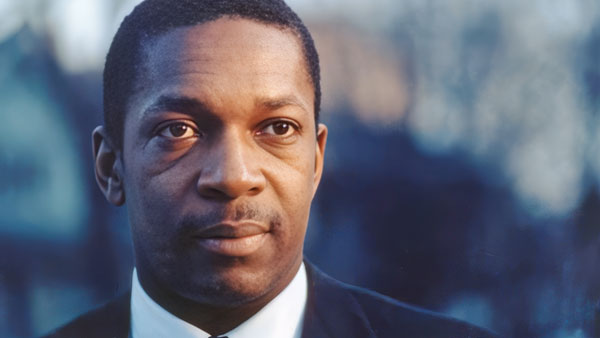
Remembering John Coltrane
spacer
By Claire Morris, KJazz Intern
Among the many beauties of music lies the idea that it can inspire and evoke audiences long after its creation—even long after the creator is there to witness its impact. Listeners of the legendary jazz composer and saxophonist John Coltrane know this much to be true. Coltrane’s boundless appreciation for music and devotion to creating art are among the several reasons he is so deeply celebrated today.
Coltrane was born on September 23rd, 1926, in the small town of Hamlet, North Carolina. He grew up during the big band era, a time in which jazz and swing thrived. Icons such as Duke Ellington and Lester Young dominated the scene with their infectious energy. These were the sounds responsible for sparking Coltrane’s infatuation with music. His early exposure to the blues began in the classroom, where he learned to play the clarinet and the horn, ultimately developing his affinity for the saxophone. Following the tragic passing of his father, along with several family members, Coltrane moved to Philadelphia in 1943. Here, he gained his first exposure to working in the music industry.
Between his studies at music schools and small gigs at local clubs, Coltrane was drafted to the Navy nearing the end of World War II. While stationed, Coltrane still found a way to exercise his love for music by recording performances with fellow sailors. Following his discharge and return to Philadelphia just over a year later, Coltrane was committed to a life of music. Playing in various local bands and ensembles, he worked his way up the ranks and began to build a name for himself in the industry. A name that would ultimately lead to his initiation into the Miles Davis Quintet in 1955.
It was his entry into the quintet that earned Coltrane national recognition. The experience proved to be educational, allowing Coltrane to fine-tune his craft and discover his own individual, dynamic sound. After roughly five years with the quintet, Coltrane was dismissed due to his longtime struggles with heroin. However, it was this severance that may have emboldened him to finally quit. Clean of his battle with drug use and involvement with the band, Coltrane clung to solo artistry as his lifeline. In 1957, he released his debut album with Prestige Records, simply titled Coltrane (1957). In the time following the record’s release, he began his six-month residency as a member of the Thelonious Monk Quartet. Monk acted as a mentor for Coltrane, urging him to break free of his conventional sound and experiment with a more spiritual, improved rhythm.
After his time with Monk, Coltrane revisited his position in the Miles Davis Quintet. His time away, however, only proved that Coltrane was too big a force to blend in with the group. Instead, Coltrane decided to gig with various bands of his own and focus solely on writing music. At this time, Coltrane transitioned from Prestige Records to be represented by Atlantic Records. Under the label, he further developed his repertoire and established a strong reputation as a composer. Leading to his final switch to Impulse! Records in 1961. It was under this representation that Coltrane released his most celebrated and loved works. His collaboration with Duke Ellington was a significant achievement, as Coltrane was now creating alongside an artist who was an early inspiration for his career. Becoming an influential figure in the jazz industry, Coltrane received strong praise—most notably for A Love Supreme (1965), a spiritual and passionate album that earned him two Grammy nominations.
Coltrane lived for creating, even to his last breath. His sudden passing in July of 1967 was not the end of his musical invention, as he had a vast collection of unreleased recordings.
His work was appreciated even after his death, earning him several Grammy Award nominations for his talent. In 1992, John Coltrane received the Grammy Lifetime Achievement Award, a moving celebration of his commitment to creation. John Coltrane will forever be known for his musical innovation and creative nature. Coltrane’s work is a testament to how musical passion and artistic creativity can connect to listeners of any kind.
Sources
Kahn, A. (2009). John Coltrane Biography.
John Coltrane.https://www.johncoltrane.com/biography
(2025). Bluenote.Com.
https://www.bluenote.com/artist/john-coltrane/
Wood, B. J. (2025, May 19). The Legendary Miles Davis and John Coltrane Quintet, 1950s -
Aoide.https://aoidemagazine.com/2025/05/19/the-legendary-miles-davis-and-john-coltrane-quintet-1950s/
John Coltrane. (1957, October). Coltrane [Album]. Prestige Records.
Coltrane, J. (1965, January). A Love Supreme [Album]. Impulse! Records.